I’ll walk you through choosing the right rug size by measuring first—never guessing. Start by assessing your seating layout, then apply the two-foot rule: position your sofa’s front legs on the rug for visual balance.
Size your rug 6–8 inches wider than the sofa on each side, extending at least two feet past its front edge. Account for walkways—leave 12–18 inches of bare floor around the edges. Standard sizes like 8×10 work for most living rooms, though 6×9 suits smaller spaces.
Mock up placement with painter’s tape before committing, and you’ll find the right fit for your room.
Measure Your Room and Seating Layout First
Where do you even start when you’re staring at your living room, wondering what size rug’ll actually work?
I’d suggest measuring your seating layout first. This foundational step helps you move from guesswork into confident decisions. Grab a tape measure and assess where your sofa sits, then consider how your other furniture relates to it. I find that anchoring your sofa visually by extending the rug beyond it on both sides creates balance and intention in the space.
As you measure your room, think about furniture legs—whether you want all of them on the rug or just the front ones touching it. I also consider walkway space, leaving adequate room to move comfortably around your furniture. This thoughtful rug placement keeps your living room feeling spacious, welcoming, and well-proportioned rather than cramped or awkward.
Determine Your Room’s Rug Capacity: 8×10 or Smaller?
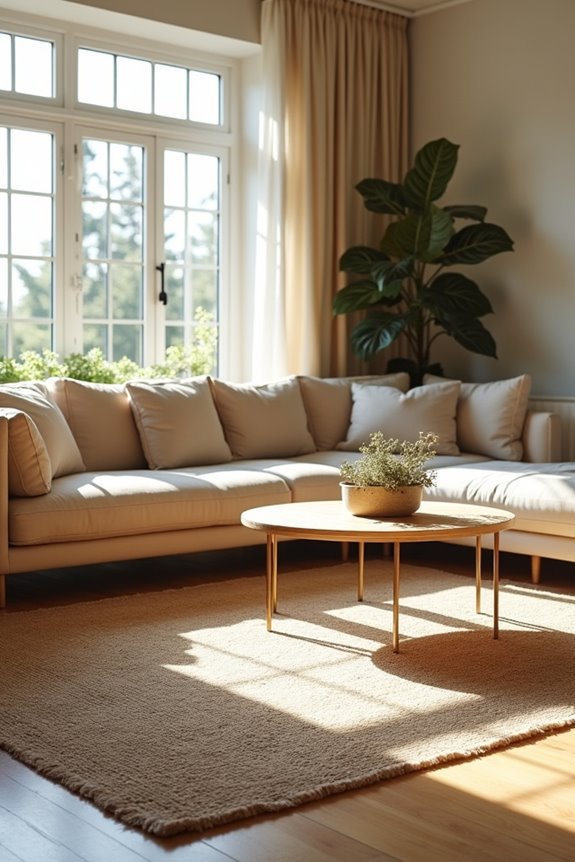
Now that you’ve mapped your room and furniture, I’ll help you figure out whether an 8×10 rug will work for your space or if you’ll need something larger. The truth is, most living rooms do well with either an 8×10 or 9×12—the standard go-to sizes that balance affordability with coverage—but your specific constraints might call for alternatives. Let’s explore how to match your room’s layout and seating needs to the right rug dimensions.
Standard Sizes For Living Rooms
How do you know which rug size actually works for your space? Understanding standard sizes helps guide your decision-making process. The 8×10 rug works well for most living rooms, offering versatility that accommodates various furniture arrangements. For larger spaces, I’d recommend considering a 9×12 rug, which keeps most furniture anchored on the rug and prevents that awkward floating feeling. If you’re working with a compact living room or tighter budget, a 6×9 rug works beautifully too. The key difference lies in your layout philosophy: all-furniture-on-rug arrangements typically call for 8×10 or 9×12, while front-legs-on-rug layouts start with 6×9 to 8×10. For open-concept layouts, bigger options like 9×12 or 10×14 unify your seating areas nicely.
Space Constraints And Alternatives
What if your living room simply doesn’t have the square footage for a standard 8×10? Space constraints don’t mean sacrificing anchored seating. You can opt for smaller rug sizes like 6×9 or 5×8, which work well in tighter spaces. Position the front legs on the rug while back legs stay on the floor—it creates visual connection without overwhelming the room. Floating a smaller rug in front of furniture is another practical alternative when budget is tight. For long, skinny living rooms, use two seating areas with separate rugs, each oriented to its own space, maintaining proportionality throughout. Adding quality rug padding underneath improves durability and comfort. These rug alternatives demonstrate that smart sizing creates comfortable, deliberate living spaces.
Apply the Two-Foot Rule to Anchor Your Space
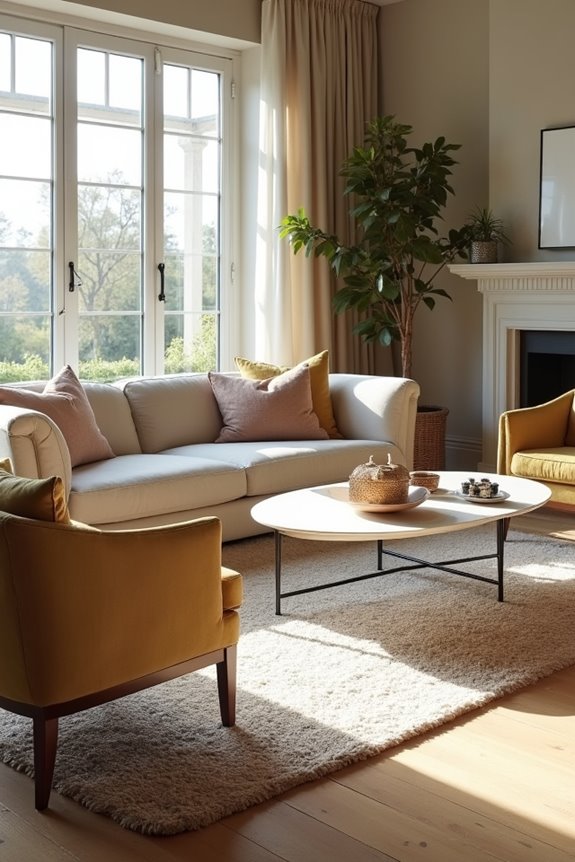
I’ve found that the two-foot rule gives me a practical framework for positioning rugs so they actually anchor my furniture rather than leaving it looking stranded. By keeping the rug at least 24 inches from walls and placing the front legs of my sofa and chairs directly on it, I create a cohesive seating arrangement. This technique, combined with selecting a rug that extends 8–12 inches beyond my furniture’s sides, improves how balanced and grounded my entire living room feels.
Creating Visual Balance
Ever notice how a living room can feel either grounded or scattered depending on where you place your rug? I’ve discovered that achieving visual balance comes down to how you position your rug under furniture. When I anchor the front legs of my seating area on the rug, the entire living room layout suddenly feels organized and connected. This simple technique changes how furniture relates to the space.
For open-plan spaces, I’ve found that a large rug that accommodates all seating pieces creates cohesion. The rug size matters less than ensuring your anchor furniture sits properly on it. Even when budget constraints limit my options, keeping front legs on the rug while maintaining a clear border around the perimeter preserves that grounded feeling. This approach makes any space feel like it belongs together.
Furniture Anchoring Techniques
Now that you’ve got the big picture of visual balance, let’s talk about the specific technique that makes it actually work—the two-foot rule. I’ve found this simple method changes how a seating area feels anchored.
The two-foot rule means positioning your sofa on the rug so the front legs sit directly on it, creating that solid visual seating anchor you’re after. Here’s what I recommend:
- Position front legs of all seating pieces on the rug for a unified appearance
- Extend your rug 6–18 inches beyond furniture on each side
- Choose a larger rug (8×10 to 9×12) for open-plan layouts
- Keep back legs on the floor if budget limits a full coverage approach
This technique helps your rug extend beyond the seating naturally, unifying the space without feeling cramped or disconnected.
Choose Your Furniture-on-Rug Configuration (All In or Front Legs?)
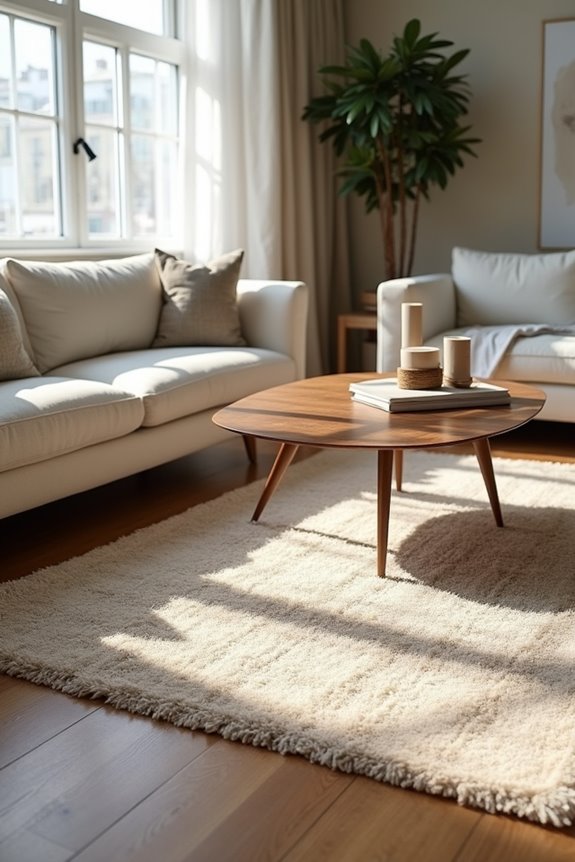
What’s the real difference between anchoring all your furniture on a rug versus just the front legs? It comes down to your space and what works for your layout.
When you place every piece on the rug—using those generous 8×10 or 10×14 living room rug sizes—you create a unified look. Everything feels connected, like the seating area belongs together.
The “front legs on the rug” configuration works well in tighter spaces. Position the rug boundary 6–18 inches from walls, keeping anchored furniture without requiring an enormous rug. Measure your seating area first, then size up so the rug extends beyond your sofa by roughly 20–30 centimeters on each side.
Both approaches work. Choose what matches your room’s needs.
Size Your Rug 6–8 Inches Wider Than Your Sofa
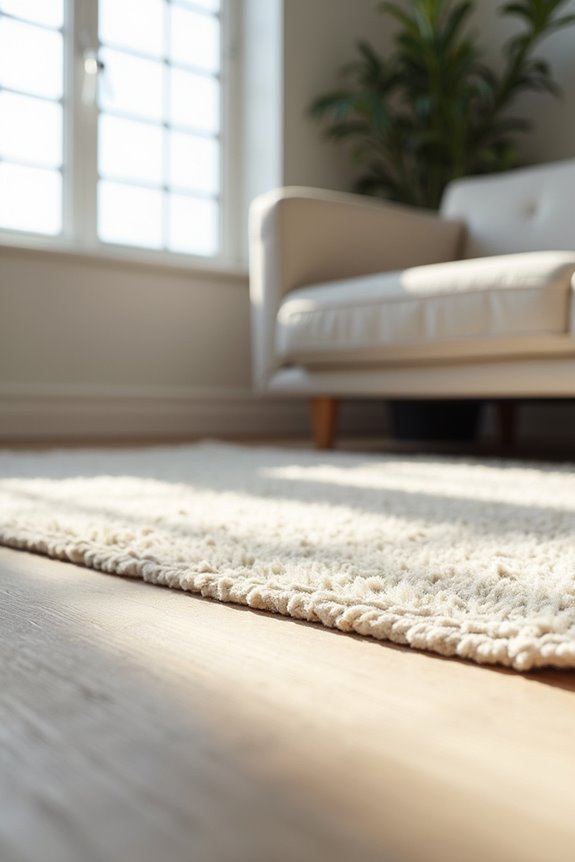
How do you know when a rug actually fits your living room? I’ve found that sizing your rug 6–8 inches wider than your sofa on each side creates visual balance. When you’re measuring your space, start with your seating area and work outward—this approach helps your rug extend appropriately beyond the furniture.
Here’s what I focus on:
- Measure your sofa width first, then add 6–8 inches on both sides
- The rug extending beyond should reach at least two feet past the sofa’s front edge
- Position the front legs of sofa on the rug whenever possible
- Verify your rug size accommodates the full seating area comfortably
This method improves how your living room feels, creating connection between furniture and floor while grounding your space with intention and warmth.
Align Your Rug to the Room’s Shape, Not Just the Sofa
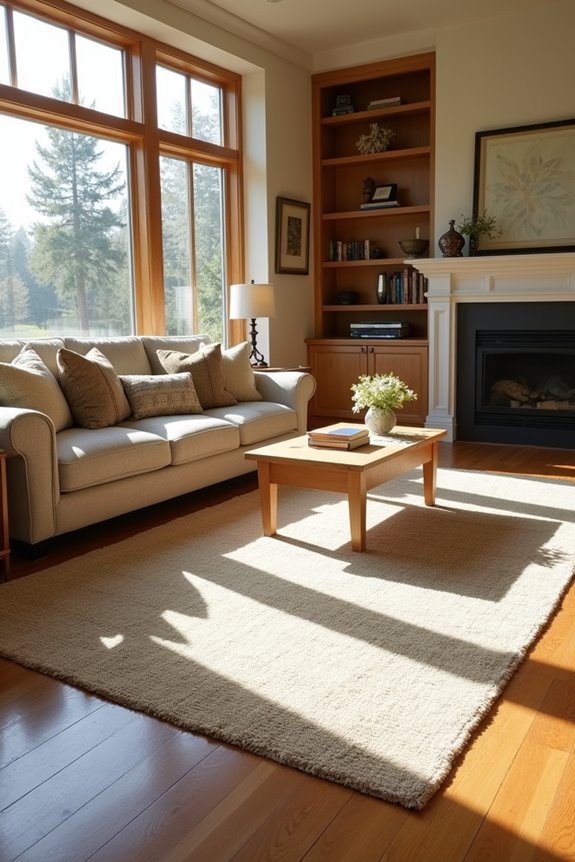
When I’m arranging a rug, I’ve learned that focusing solely on my sofa actually works against me—the real benefit comes from considering how the entire room’s shape influences the rug’s placement. I find that aligning my rug to match the room’s proportions, rather than just sizing it to my furniture, creates a sense of visual balance that makes everything feel deliberate and grounded. By extending the rug beyond my seating on both sides and maintaining thoughtful clearance to the walls, I’m creating a visual frame that connects the whole space together instead of letting it feel disconnected.
Room Layout Over Furniture
Why do so many of us size our rugs around the sofa when the room itself is what really matters? I’ve learned that your living room layout should guide your rug size, not the furniture placement alone. When I anchor seating with a rug that extends 20–30 cm beyond my furniture on each side, the entire space feels cohesive.
Here’s what I prioritize:
- Measure your room’s perimeter using painter’s tape to visualize proportions
- Position front legs on the rug to create visual balance
- In open concept spaces, choose dimensions that unify living and dining areas
- For long rooms, consider two separate rugs matching the room’s shape
This approach changes how I experience my living room. By respecting room proportions over furniture placement alone, I’ve created spaces where everything belongs.
Orientation Maximizes Visual Balance
Once you’ve sized your rug to fit your room’s proportions, the next layer—and honestly, the one that ties everything together—is getting its orientation right. I’ve learned that aligning your area rug with your room layout matters far more than simply matching your sofa’s direction. In long, narrow spaces, I orient my living room rug lengthwise to guide traffic naturally, while compact rooms benefit from horizontal placement. This approach helps define the space and maintains visual flow throughout. When positioning your seating arrangement, consider how the edge of the rug interacts with your room furniture as a whole. A quality rug pad stabilizes everything in place. By prioritizing room layout over individual pieces, you’ll create balance that welcomes everyone in, making your living room feel deliberately designed rather than accidentally arranged.
Account for Walkways and Traffic Flow
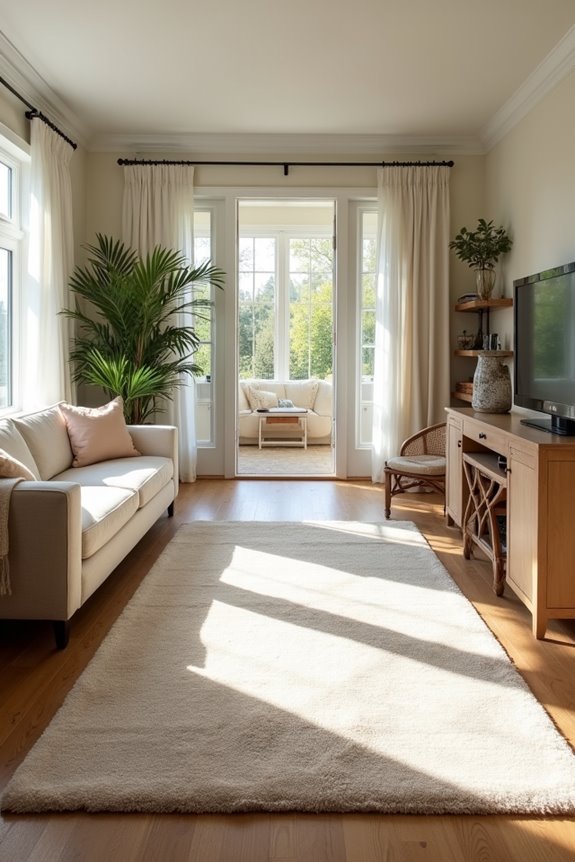
How many times have you stubbed your toe on a rug edge while hurrying through your living room? Thoughtful traffic flow prevents frustration and keeps your space feeling well-planned.
I leave about 12–18 inches of bare floor space around rug edges, creating clear walkways that don’t interrupt movement. This breathing room matters especially in high-traffic living rooms where safety is a priority. I also position the rug to extend beyond the sofa by 20–30 cm on each side, anchoring the seating area without blocking passages.
Here’s what I prioritize:
- Position front legs on rug for visual cohesion
- Choose lower-pile rugs in busy zones
- Maintain unobstructed doorway access
- Test your typical walking paths
When your rug size respects circulation patterns, everyone moves through naturally. You’ll notice how intentional spacing creates a room that feels calm rather than cluttered.
Pick a Standard Size That Fits Your Room
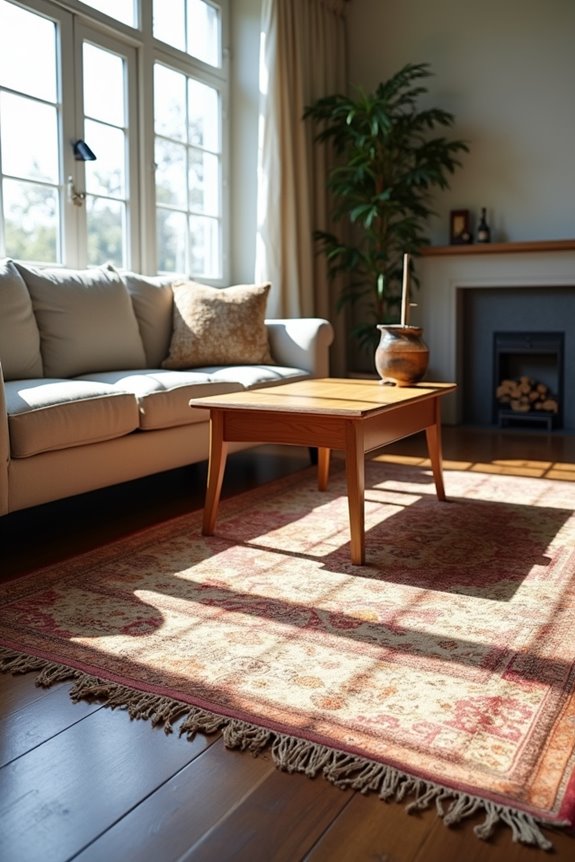
Now that you’ve mapped out your traffic patterns, you’re ready to pick a rug size that works with your room’s dimensions. An 8×10 rug serves as the standard size for most living rooms, creating a balanced feel. If your space runs larger, a 9×12 rug keeps all your seating anchored on the same surface. For smaller rooms, consider a 6×9 or 5×8 instead. Position your rug so the front two feet of sofas land on it, or place everything together for a unified look. Leave 12–18 inches of bare floor showing around edges to frame the space. In open plan areas, larger rugs unify different zones while maintaining the breathing room you need.
Spot Common Undersizing Mistakes
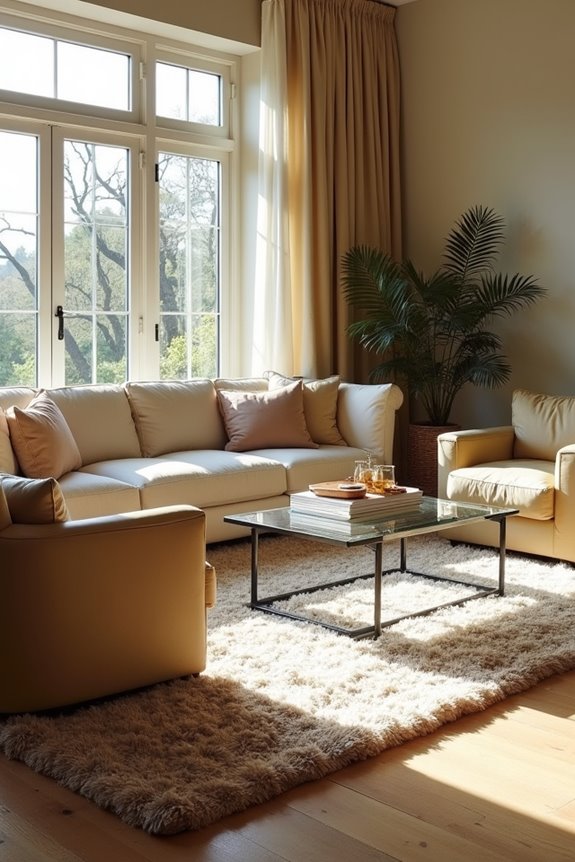
Why do so many living rooms feel scattered and disconnected? I’ve found that undersizing your rug is often the culprit. When I choose a rug that doesn’t reach at least the front legs of my sofa and chairs, the space loses cohesion. Here’s what I’ve learned to avoid:
- Selecting a rug smaller than your sofa width, which visually truncates the seating area
- Leaving furniture edges extending beyond the rug, creating harsh transitions
- Neglecting the 12–18 inches of bare floor needed around edges for movement
- Ignoring layout options like “all furniture on rug” for open-plan spaces
I’ve discovered that considering my room layout beforehand prevents these missteps. Whether I’m positioning just front legs or entire pieces on the rug, proper rug size creates a unified, welcoming living room that works well functionally and visually.
Mock Up Your Rug Placement Before Buying
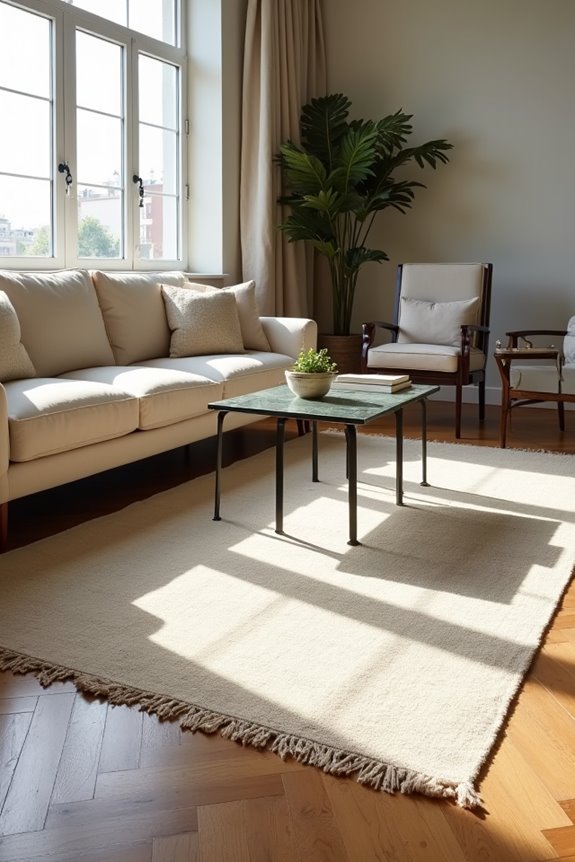
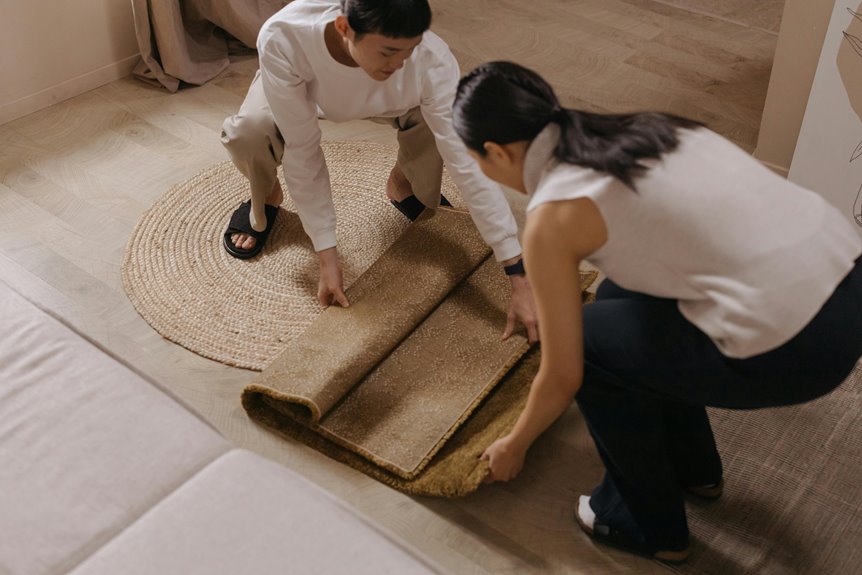
Before you commit to buying a rug, I’ve learned the hard way that laying it out first saves both money and frustration. I grab painter’s tape or newspaper to map my living room’s actual dimensions, testing different rug placements against my furniture layout. This mock-up phase reveals whether my seating arrangement truly fits the rug size I’m considering.
| Layout Option | Best For |
|---|---|
| All furniture on rug | Unified, anchored spaces |
| Front legs only | Defined seating zones |
| Floating rug | Open, spacious feeling |
| Edge clearance testing | Practical flow assessment |