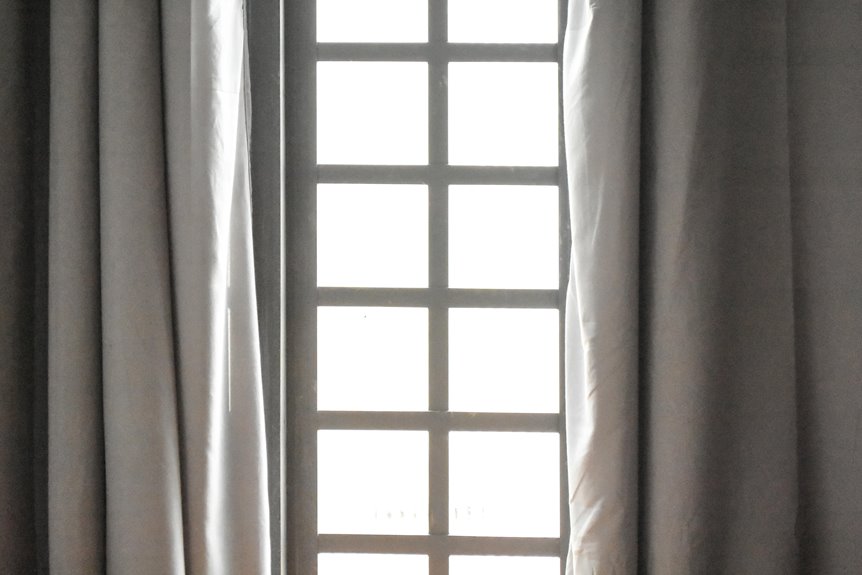
Standard blackout curtains block light effectively, but they’re just okay at fighting cold—that’s the reality most folks don’t expect. They’ll help somewhat, but thermal-lined blackout curtains are your best option for cold protection because they trap heat with insulated backing instead of relying on dense fabric alone.
Want genuine winter protection? You’ll want to know the specific techniques that separate adequate from effective performance.
Do Blackout Curtains Block Cold? The Short Answer
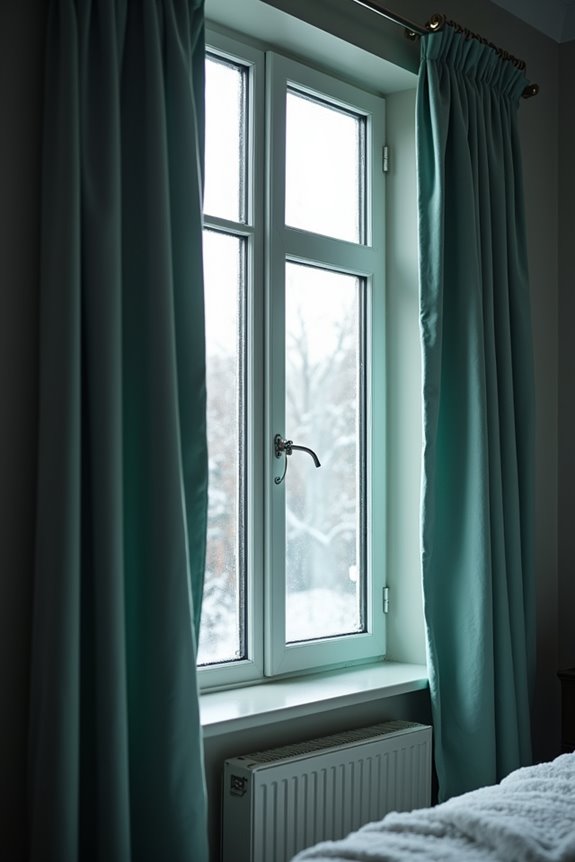
How much cold can blackout curtains actually keep out? Standard blackout curtains alone won’t completely block cold—they’re primarily designed for darkness. However, thermal-backed blackout curtains work differently. These feature special linings that reduce heat transfer and reflect warmth back into your room, which does make a noticeable difference during winter.
Here’s the catch: installation matters tremendously. Leaving gaps around the edges defeats the purpose entirely. When you seal your curtains properly at the sides, top, and bottom, you’ll feel noticeably fewer drafts. The heavier materials, like velvet blends, perform better than lighter fabrics. Pairing thermal blackout curtains with cellular shades creates an even stronger barrier. They’ll help—but only when you’re intentional about both your choice and setup.
How Cold Air Actually Enters Your Home Through Windows

Why do some rooms stay chilly no matter how high you crank the heat? I’ve found that cold air sneaks in through windows in several specific ways. Here’s what’s actually happening:
- Gaps along frames let drafts pour directly into your space
- Single-pane glass transfers cold far more readily than modern alternatives
- Worn seals and joints in older windows create persistent leaks
- Uninsulated sills and edges act as cold pathways between window and room
- Structural weaknesses mean cold dominates heat loss despite strong heating
I realized my heating system couldn’t compete with this constant air infiltration. Even premium furnaces struggle when windows leak continuously. The cold doesn’t just whisper around edges—it actively flows inward, overwhelming your heat efforts. Understanding these entry points helped me finally address what was making my home feel perpetually uncomfortable.
Blackout vs. Thermal: Which Actually Blocks Cold?
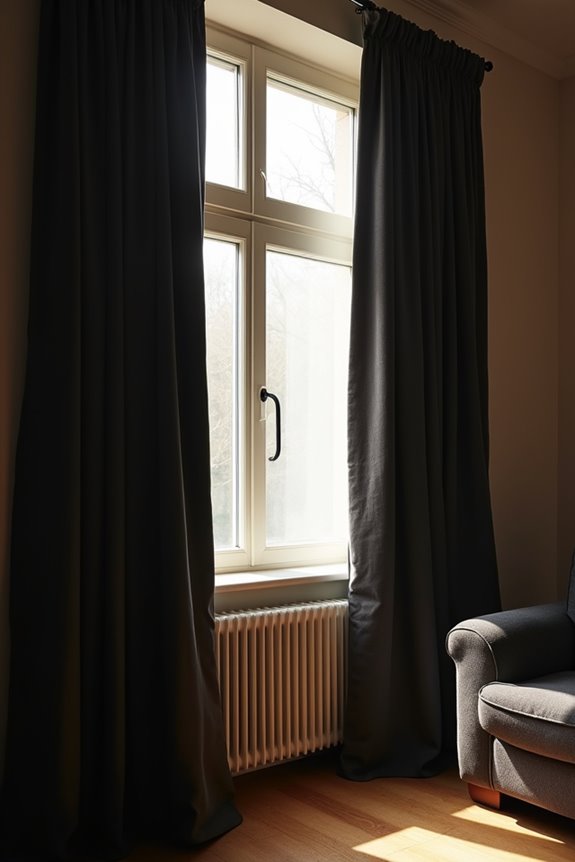
Now that I’d identified where the cold was sneaking in, I realized my next problem: I needed to actually stop it. I discovered that not all curtains perform equally. Standard blackout curtains block light beautifully, but they’re honestly just okay at fighting cold. Thermal curtains, however, create an air-trapping barrier that reduces heat transfer—something I couldn’t ignore. The difference comes down to their specialized lining. I learned that pairing blackout fabric with thermal backing gives you the best of both worlds. Heavyweight materials like velvet and wool blends further enhance insulation, slowing cold drafts significantly. For maximum winter protection, I’d recommend seeking 100% blackout thermal-lined options. The investment felt worthwhile once I understood how these layers work together, making your windows actual barriers against the cold.
Thermal Lining: Why It Matters More Than Darkness
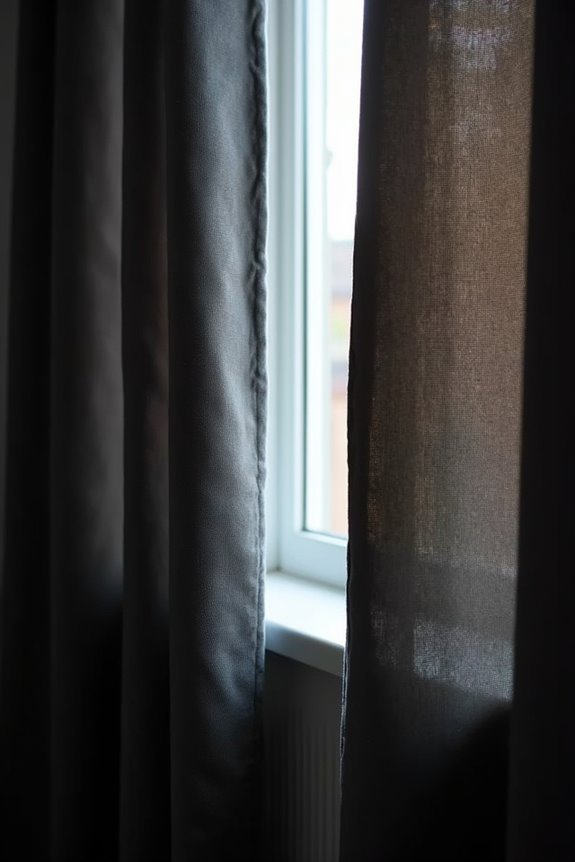
When I finally held a thermal-lined curtain against the light, I understood something fundamental: the darkness I’d been chasing wasn’t actually doing the substantial work against cold.
The real benefit? Thermal lining itself. Here’s what actually matters:
- Insulating barrier: Creates separation between window and room, reducing heat transfer regardless of fabric color
- Multiple foam layers: Acrylic layers seal the weave and slow airflow effectively
- Solar reflection: Bounces radiation before fibers saturate, keeping heat outside
- Energy savings: Paired with proper installation, these curtains deliver measurable heating and cooling benefits
- Layering strategy: Combining thermal blackout with white backsides and tight wall seals maximizes heat rejection
I’d wasted mental energy obsessing over how dark my curtains looked. What actually protects your home is what you can’t see—that hardworking thermal lining silently battling the cold, doing the work darkness simply can’t.
White vs. Dark Backing: The Color Rule for Thermal Curtains
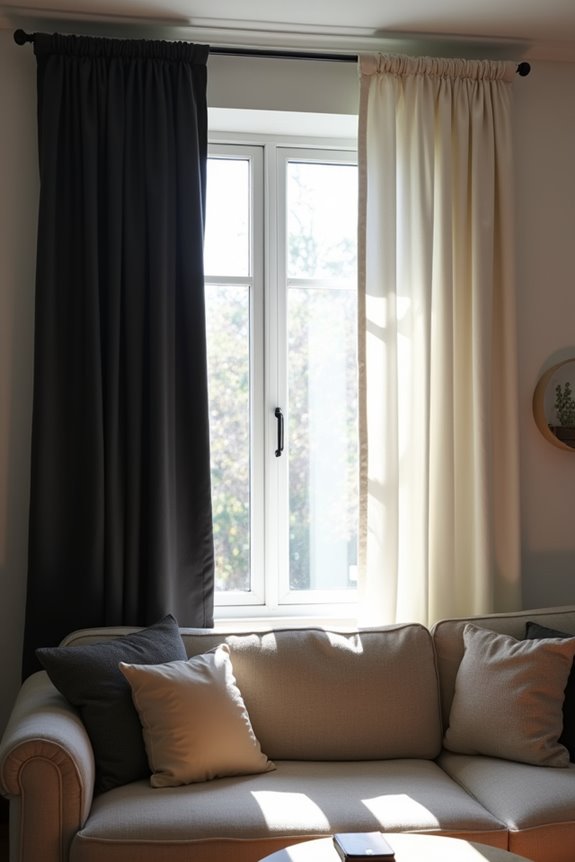
When I first learned about backing colors, I realized I’d been thinking about curtains all wrong—the side facing your window matters just as much as the side facing your room. Here’s what I discovered: white or light-colored backing reflects solar radiation back through the glass before it becomes heat, while dark backing absorbs that energy and traps warmth right where you don’t want it. This strategic color placement, combined with thermal lining, creates an effective combination that keeps your space cooler in summer and more insulated in winter.
Light Absorption vs. Reflection
Why does the back of a curtain matter as much as the front? I’ve discovered that surface reflection is genuinely your primary tactic against temperature loss. Here’s what I’ve learned works:
- Dark backings absorb solar energy, converting it to heat near windows
- White or light backings reflect sun’s rays away before they enter your room
- Black backing actually increases heat near the window, reducing overall rejection
- Light-colored backing bounces solar radiation back through glass
- The color rule minimizes heat gain by reflecting energy away from indoor spaces
I’ll be honest—I was taken aback by how much backing color impacts your comfort. When you choose white or off-white backing, you’re creating a bounce-back system that keeps cold air from penetrating your space during winter months. It’s physics working in your favor, making your home feel warmer without extra effort.
Strategic Color Placement Strategy
I realized that the color facing your window matters far more than the color facing your room. I used to think dark curtains were purely aesthetic, but I discovered the science behind strategic placement. A white backing reflects solar radiation back through the glass, keeping heat from entering during sunny days. Meanwhile, I could still enjoy a dark front for my room’s style. This combination gives me the best of both worlds—visual appeal without sacrificing thermal performance. When I switched to curtains with white backing, I noticed cooler temperatures near my windows on bright afternoons. It’s a simple adjustment that changed how I approach energy efficiency and home comfort.
Thermal Performance By Backing
Once you understand the backing color rule, you’ll realize it’s the hidden factor of thermal curtains—the part nobody sees that actually does most of the work.
I’ve learned that white backing is an effective choice for keeping cold out:
- White backing reflects solar radiation back through the glass, minimizing heat loss
- Black backing absorbs energy, creating hot air pockets that actually work against you
- The side facing glass matters most, not your room’s aesthetic
- Dark front-facing fabric stays acceptable when paired with white backing underneath
- Proper layering combines white-backed curtains on windows with decorative fabric facing inward
Think of it this way: you’re building a thermal shield. The white backing bounces cold away before it penetrates your space, while dark front-facing layers keep your room looking intentional. This combination gives you both performance and style—exactly what you need in your home.
The Chimney Effect: An Installation Flaw in Blackout Curtains
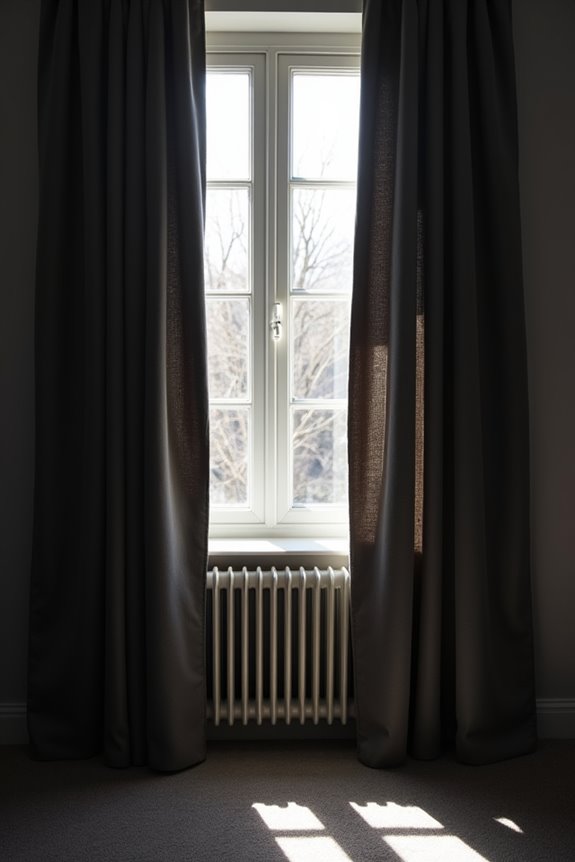
Have you ever noticed how your heating bill stays stubbornly high even after you’ve hung expensive blackout curtains, only to discover the culprit isn’t the fabric itself but rather how you’ve installed it? I learned this the hard way. The problem is the chimney effect—a convection loop that forms between your window and curtain when gaps exist. Hot air rises along the glass, escapes through openings at the top, and pulls warm room air behind it. Your curtains work against your heating efficiency when not properly sealed. To stop this, I curved my rod so fabric touches the walls, overlapped panels by four inches, and let them barely graze the floor. These adjustments sealed those gaps and reduced my energy costs.
The Most Effective Fabrics for Blocking Winter Cold
What’s the difference between a curtain that merely looks heavy and one that actually performs like a thermal barrier? I’ve discovered it’s all about the fabric composition and construction.
Here’s what I’ve learned works best:
- Thermal blackout panels combine insulation with light-blocking properties for superior winter performance
- Velvet and wool blends create dense weaves that trap air effectively
- Dense linen fabrics minimize drafts seeping through gaps
- Heavyweight materials slow heat transfer between your window and room
- Layering inner thermal panels with outer curtains increases air pockets dramatically
I’ve found that custom-sized, full-window coverage matters too. When your curtains fit properly without gaps, you’re not just blocking light—you’re genuinely protecting your space from cold. The right fabric isn’t just about appearance; it’s about creating real insulation that keeps your home warmer throughout winter.
Which Wins: Blackout, Cellular, or Thermal?
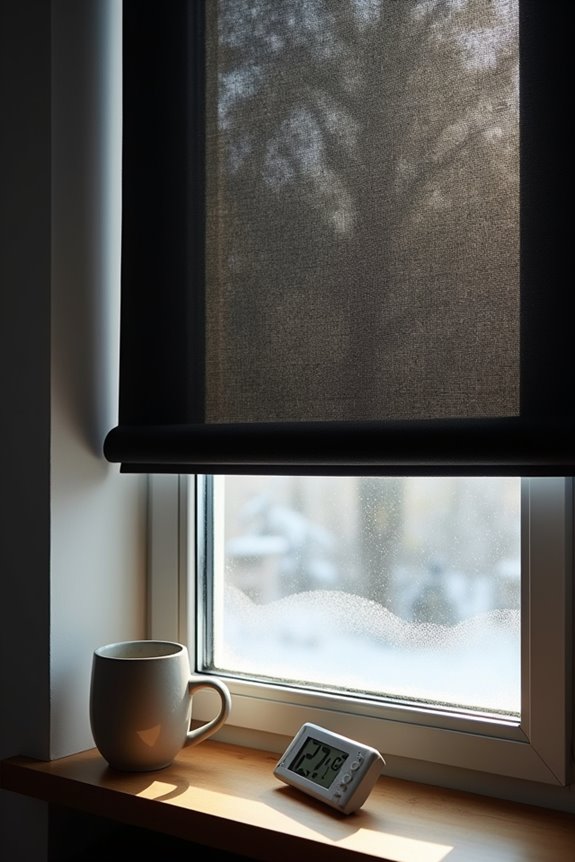
When I compare these three heavyweights, I realize there’s no single champion—blackout curtains excel at blocking light with their dense, layered construction, while cellular shades win the pure thermal battle through their air-trapping honeycomb design, and thermal curtains split the difference by delivering respectable insulation without always achieving total darkness. Each option brings distinct strengths to your windows, so what matters most is matching the right solution to your specific needs and installation setup. The real advantage happens when you combine them strategically, layering cellular shades inside the frame with blackout curtains outside to create a fortress against both cold and unwanted light.
Blackout’s Light-Blocking Advantage
If you’ve ever stood in a darkened room at noon and felt genuinely surprised by how black it actually got, you’ve experienced what a true blackout curtain can do—and honestly, that 100% light-blocking capability is hard to beat when darkness is your primary goal.
What makes blackout curtains effective in the light-control category:
- True blackout fabric stops every ray from entering
- Properly lined designs eliminate pesky side gaps
- They create theater-quality darkness reliably
- Installation seals frame edges effectively
- Privacy becomes absolute, day or night
Blackout curtains keep cold out reasonably well through their dense construction, but they’re not energy champions compared to cellular shades. Still, when you need that complete darkness—whether you’re sleeping during daylight or managing light sensitivity—blackout curtains deliver what others can’t quite match.
Cellular Shades’ Thermal Edge
Cellular shades outperform blackout curtains regarding trapping heat, thanks to those honeycomb-shaped air pockets built into their fabric. These thermal cells create insulating barriers per square inch that blackout options can’t match alone. The air pockets work like tiny insulation chambers, keeping cold from entering your windows during winter months. What stands out is that cellular shades do this without the bulk of heavy curtains. They’re sleek, unobtrusive, and effective—which makes them ideal if you want serious warmth retention without sacrificing your room’s aesthetic. That said, they’re not invincible against poor installation, so proper fitting matters tremendously.
Thermal Curtains’ Dual Performance
After testing various window treatments in my own drafty bedroom, I’ve found that thermal curtains offer something the other options can’t quite match—they’re reliable performers in temperature control, working hard on both sides of the seasonal battle.
Here’s what makes thermal curtains stand out:
- Insulated lining traps heat during winter months, keeping warmth exactly where you need it
- Reflects summer heat outward, preventing your room from becoming an oven
- Blocks light effectively when lined with blackout backing
- Seals window gaps better than standalone options
- Versatile styling fits any décor while delivering solid performance
Unlike cellular shades or blackout curtains alone, thermal curtains handle both seasons with equal dedication. I’ve noticed my heating bills dropped noticeably after installation. They’re the investment that keeps giving, protecting your comfort year-round without requiring complicated layering systems.
Sizing Your Curtains for Maximum Warmth
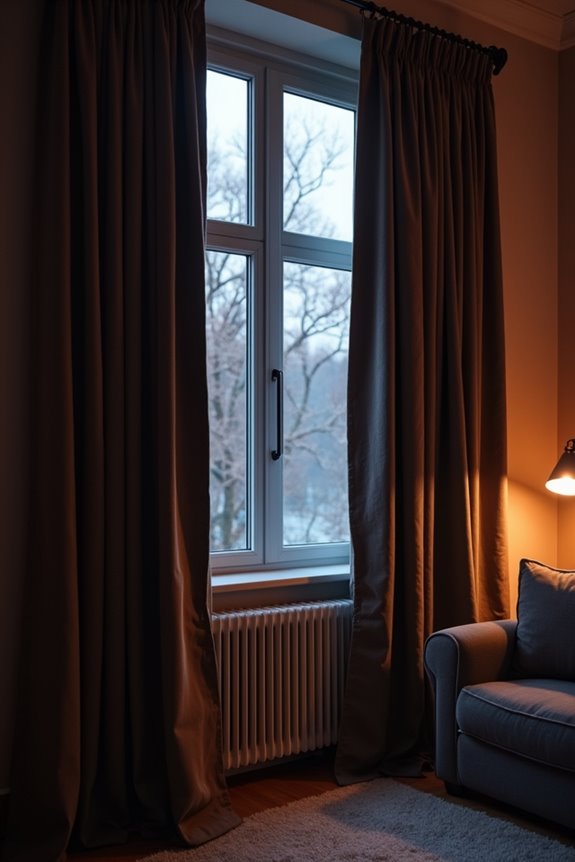
Just how much difference can curtain dimensions really make in keeping your home warm? Sizing matters tremendously. When I extended my curtain rods beyond the window frame, I created a tighter seal against drafts that I hadn’t realized was slipping through. Mounting thermal blackout curtains higher toward the ceiling actually interrupts rising warm air, which proved effective.
I switched to floor-length panels instead of standard lengths, and the difference was noticeable. That extra fabric sealing the bottom gap prevents cold air from sneaking in at ground level. I’ve also layered a sheer panel underneath my thermal blackout curtains, trapping air between them for enhanced insulation.
Custom-sized curtains that fully cover your windows eliminate those frustrating light and cold leaks around edges. You’re not just hanging fabric; you’re investing in your home’s comfort.
Layering Thermal Curtains: The Ultimate Cold-Blocking Strategy
When I stopped fighting my windows and started layering my curtains instead, my home felt noticeably warmer during winter. Combining thermal and blackout options creates genuine energy efficiency improvements.
Here’s what worked:
- Inner thermal blackout curtains trap warm air through insulated linings
- Outer decorative thermal curtains add aesthetic appeal without sacrificing warmth
- Layered setups create air pockets that slow heat transfer significantly
- Custom sizing eliminates gaps that cause drafty convection loops
- Proper installation—extending rods beyond frames and mounting near ceilings—maximizes insulation
These elements work together effectively. I’m no longer just blocking light; I’m actively protecting my home’s warmth. This strategy aligns with others who’ve discovered that smart window solutions don’t require sacrificing style or spending excessively.
Choosing the Right Blackout Curtain: Style, Budget, and Cold-Blocking Priorities
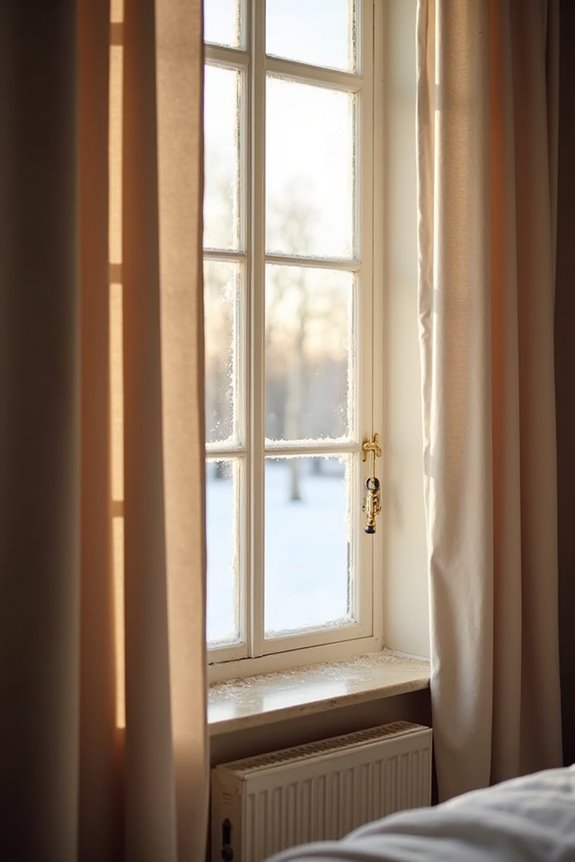
Now that you’ve got the layering concept down, the real challenge becomes picking curtains that actually deliver on both warmth and style while staying within budget. I’ve found that blackout curtains with thermal backing offer a solid middle ground between function and aesthetics. You’re not locked into boring beige—modern options come in rich jewel tones, subtle grays, and elegant patterns that work with any room.
| Factor | Budget-Friendly | Premium |
|---|---|---|
| Material | Polyester blend | Velvet, wool |
| Insulation | Basic thermal | Advanced backing |
| Durability | 3-5 years | 7+ years |
Consider your priorities honestly. Need maximum cold-blocking? Invest in heavyweight fabrics. Prefer flexibility? Lightweight thermal options work too. I recommend measuring twice, checking rod placement, and choosing floor-length styles that seal gaps effectively, so your choice performs well for your space and lifestyle.