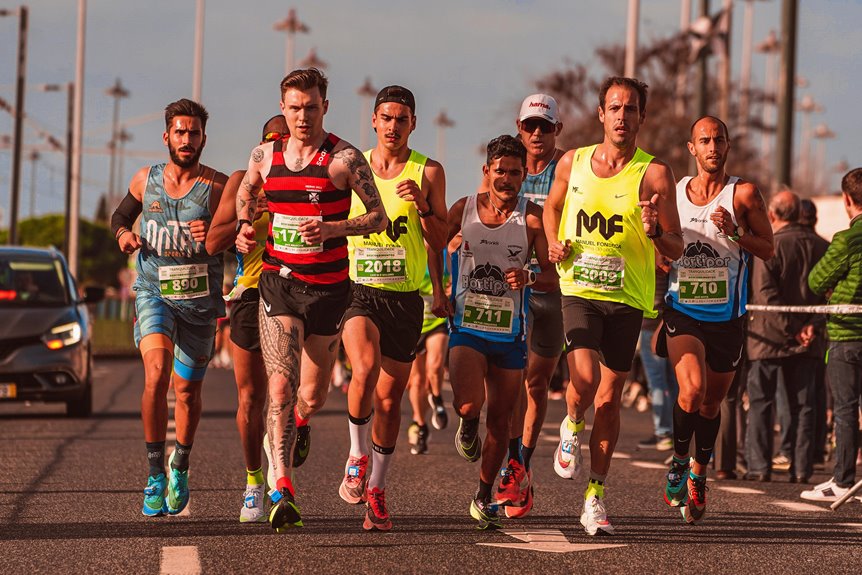
A Backyard Ultra flips everything you’d expect from racing—instead of chasing a finish line, you’re chasing the last person standing. You’ll complete a 4.167-mile loop every single hour until you can’t anymore. Miss that hour-long window, and you’re out. The runner who finishes their lap as the clock strikes remains in the race; everyone else drops out. It’s brutally simple: outlast your competition, not the distance itself. The real challenge emerges once you understand what this format demands from your body and mind.
What Is a Backyard Ultra?
How’s this for an unconventional race: you’ve got one hour to complete a 4.167-mile loop, and then you do it again, and again, until you’re the last person standing. That’s the Backyard Ultra format, a competition unlike anything you’ve experienced in running. Created by Lazarus Lake (Gary Cantrell) in 2011, this event strips away traditional finish lines and predetermined distances. Instead, runners face a simple victory condition: be the only person crossing that loop as the clock strikes the hour. Complete a lap every hour for 24 hours, and you’ll cover 167 miles—a staggering achievement. But here’s what makes this format special: you’re not just racing a course. You’re racing everyone else, racing fatigue, racing time itself. Eventually, only one finisher remains.
How Does the Hourly Loop Format Work?
I’ve got to tell you, what makes a Backyard Ultra so uniquely brutal is its hourly structure—you’ve got sixty minutes to complete that 4.167-mile loop and cross the finish line, period. Each hour brings a fresh starting gun, and if you don’t make it back before that hour ends, you’re done, even if you’re just steps away. This relentless rhythm means you’re not just racing distance; you’re racing the clock, hour after hour, until only one runner remains standing.
The Hourly Starting Line
What makes a backyard ultra so relentlessly different from other ultramarathons? The hourly starting line, that’s what. Every single hour, on the dot, we line up again for another lap. No mercy, no flexibility—just you, the yard, and the clock.
| Hour | Distance | Challenge |
|---|---|---|
| Hour 1 | 4.167 miles | Fresh legs |
| Hour 12 | 50 miles | Fatigue sets in |
| Hour 24 | 100 miles | Mental warfare |
This relentless cycle continues until only one runner finishes a lap alone. Everyone else? DNF. The finish line isn’t predetermined; it arrives whenever someone finds themselves standing there without competition. That’s the beauty of it—we’re not racing against distance, but against each other, hour after hour, until someone breaks last.
Loop Completion Requirements
Because every hour matters in a backyard ultra, you’re working with a fixed loop of 4.167 miles—a distance that’s been deliberately calculated so twenty-four laps equal one hundred miles, the holy grail of ultrarunning. Here’s what makes this format beautifully brutal: you must complete your loop within that one-hour limit, starting at the exact-hour mark. If you finish early, you’ll rest until the next hour begins—a mental game as much as a physical one. Those who can’t complete the 167-mile loop within the one-hour window become DNFs, dropping out as the competition narrows. Only the last person standing, among all remaining lappers, ultimately prevails. This structure transforms endurance racing into something almost primal.
The Last-Person-Standing Winner Structure
Unlike traditional races with predetermined finish lines and set distances, a Backyard Ultra determines its winner through pure endurance—only when every other runner has dropped out does the final competitor cross an imaginary finish line. I find this format beautifully simple: you keep running laps on the hour until you’re the only one left standing. Once the second-to-last runner can’t complete their lap, the winner must finish one additional loop alone. Everyone else? They’re recorded as DNFs, though there’s no shame in that—you’ve pushed yourself harder than most ever will. The last-person-standing structure transforms this Backyard Ultra into something deeply personal, where victory isn’t about speed but resilience and mental toughness.
How to Pace a Backyard Ultra: Race Strategy and Pacing
How you run those early laps might just determine whether you’re standing alone at the finish or limping back to the aid station for the last time.
Your Backyard Ultra strategy hinges on understanding that each lap demands completion within one hour. I’ve learned that pacing yourself conservatively early pays dividends when competitors fade. You’re not racing against the clock—you’re outlasting others.
| Phase | Strategy | Focus |
|---|---|---|
| Laps 1-8 | Controlled effort | Build confidence |
| Laps 9-16 | Steady maintenance | Mental toughness |
| Laps 17+ | Dig deep | Become sole finisher |
The finishers I’ve known shared common traits: patience during early hours, honest self-assessment at halfway, and relentless consistency. Your pacing isn’t about speed—it’s about arriving at each hour’s start line ready to continue. That’s how you join the community of Backyard Ultra survivors.
Nutrition and Recovery Between Laps
When you’re standing at the aid station with your heart still pounding and sixty minutes stretched ahead before the next lap begins, you’ve got a narrow window to refuel your body and reset your mind. I’ve learned that fueling with 200–250 calories per hour—mixing gels, real foods, and salty items—keeps me moving through those brutal Backyard Ultra laps. I prioritize electrolytes and hydration first, then tackle nutrition while my crew handles sock changes and gear adjustments. This recovery period isn’t just about eating; it’s about mentally preparing for the next push. Between-lap rest transforms how I feel on that next lap. When I nail my nutrition strategy, I’m not just surviving—I’m staying competitive, energized, and part of this incredible community pushing through together.
Building Mental Resilience for Extended Laps

Why does the mental game matter more than your fitness level in a Backyard Ultra? Because when you’re grinding through hourly laps in a last-person-standing event, your legs will betray you long before your mind needs to. I’ve watched runners with tremendous fitness drop out while mentally tougher competitors pushed forward. Gary Cantrell’s ultramarathon format demands relentless psychological strength—you’re not racing against the clock; you’re battling yourself every single hour. Building mental resilience means accepting discomfort as your companion, not your enemy. It means finding reasons to keep moving when quitting feels reasonable. The beauty of Backyard Ultra racing lies here: we discover we’re capable of far more than we imagined, strengthening our resolve lap after lap.
Backyard Ultra World Records and Champions
Since Gary Cantrell invented this format, the records set in Backyard Ultras tell a story of human endurance that’s almost impossible to believe—runners pushing through 100+ miles on loops barely longer than a 10K, hour after hour. Phil Gore’s men’s world record of 119 laps (nearly 496 miles) at Dead Cow Gully in Australia showcases what dedication looks like, with Sam Harvey providing essential support as his assist. Sarah Perry’s women’s world record of 95 laps demonstrates that these distances aren’t just male territory. What strikes me most is how these athletes lap the same 4.167-mile loop repeatedly, transforming monotony into meditation. You’re witnessing the absolute limits of human persistence, where mental toughness matters as much as physical conditioning.